
Oshun, also written Osun or Ọ̀ṣun, is one of the most widely known Orishas in Yoruba religious traditions. She is strongly associated with fresh water, fertility, beauty, sweetness, sensuality, and aspects of human well-being.
Her significance is closely connected with the natural world, particularly rivers and other sources of fresh water. The Osun-Osogbo Sacred Grove in southwestern Nigeria, recognized as a UNESCO World Heritage Site, remains an important living center of Yoruba religious and cultural traditions associated with Oshun. UNESCO describes the grove as the abode of Osun and notes that it contains shrines, sculptures, artworks, and sacred places connected with the Yoruba pantheon. citeturn1search0turn1search2
For people beginning to learn about Yoruba spirituality, however, Oshun is sometimes reduced to a few modern associations such as love, beauty, or money.
Those associations are part of how Oshun is understood in some traditions, particularly across the African diaspora, but they do not fully explain her significance.
Oshun’s traditions connect water, fertility, prosperity, femininity, relationships, beauty, sweetness, and the sustaining forces of life. Understanding these connections provides a much richer picture of this important Orisha.
Who Is Oshun?
Oshun is an Orisha associated with fresh water and is particularly connected with rivers.
In Yoruba tradition, Orishas are divine beings associated with different aspects of the natural and spiritual world. Oshun is one of the prominent Orishas whose worship has remained important in Yorubaland and throughout the African diaspora.
Her connection with water is particularly significant because fresh water is essential for life.
The relationship between Oshun and water is not simply symbolic. The Osun River and the Osun-Osogbo Sacred Grove form an important cultural and religious landscape in Nigeria. UNESCO describes the river as the spiritual abode of Osun and the grove as a living religious site where worship continues today. citeturn1search0
Oshun is therefore best understood not simply as an Orisha “of love,” but as a complex figure whose traditions connect water, fertility, beauty, sweetness, prosperity, and human relationships.

What Does Oshun Mean?
When people search for Oshun meaning, they are often looking for a simple definition.
There is no single English word that adequately captures Oshun’s significance.
She is commonly associated with:
- fresh water;
- rivers;
- fertility;
- beauty;
- sweetness;
- sensuality;
- prosperity;
- abundance;
- femininity;
- relationships;
- care and well-being.
Some of these associations are particularly prominent in African diaspora traditions, while others are rooted in Yoruba traditions connected to the Osun River and Osun-Osogbo.
The important point is that these characteristics should not be treated as isolated “powers.”
They are interconnected.
Water sustains life.
Fertility allows life to continue.
Sweetness represents qualities that attract and nourish.
Beauty and sensuality can be connected with human relationships and vitality.
Prosperity and abundance relate to the conditions that allow communities and individuals to flourish.
Seen this way, Oshun represents a much broader idea of life-giving and sustaining forces.
Oshun and Fresh Water
Water is perhaps the most important natural association of Oshun.
Unlike Yemaya, whose traditions are strongly associated with the sea and motherhood in many Afro-diasporic contexts, Oshun is especially connected with fresh water and rivers.
The Osun River is central to the religious landscape surrounding the Osun-Osogbo Sacred Grove.
UNESCO identifies the river as the spiritual abode of Osun and describes the grove as a sacred landscape containing shrines, sculptures, and other works dedicated to Osun and other Yoruba deities. citeturn1search0
This relationship between Oshun and water is important when understanding her wider symbolism.
A river moves, nourishes, connects places, and sustains ecosystems.
Water is also essential for human life, agriculture, and fertility.
Consequently, Oshun’s connection to water helps explain why fertility, abundance, beauty, and prosperity appear among the themes associated with her.
Oshun and Fertility
Oshun is strongly associated with fertility.
UNESCO describes the Osun-Osogbo Sacred Grove as the abode of the Yoruba goddess of fertility and emphasizes the continuing religious significance of the site. citeturn1search0
Fertility should not be interpreted exclusively as pregnancy.
Within a broader cultural and religious context, fertility can also be understood in relation to the continuation and flourishing of life.
The relationship between water and fertility is therefore particularly meaningful.
Without water, crops cannot grow and human communities cannot survive.
This helps explain why a river-associated Orisha can also be connected with fertility and abundance.
Oshun and Beauty
Beauty is another widely recognized association with Oshun.
In many representations and traditions, Oshun is portrayed as feminine, elegant, attractive, and associated with adornment.
However, it is important not to reduce this association to modern ideas of physical appearance.
Beauty can also function as a cultural and spiritual concept involving attraction, harmony, refinement, pleasure, and the qualities that draw people toward one another.
This broader interpretation helps explain why beauty and sweetness are often discussed together when describing Oshun.
Rather than treating beauty as superficial, the tradition can be approached as part of a larger understanding of attraction, relationship, vitality, and abundance.
Oshun and Sweetness
Oshun is frequently associated with sweetness.
This association is reflected in the way Oshun is discussed in both Yoruba and African diaspora traditions.
Sweetness can be understood literally through foods and substances associated with offerings in particular traditions, but it also has a symbolic dimension.
Sweetness contrasts with bitterness.
It can represent pleasantness, attraction, affection, generosity, and the qualities that make relationships harmonious.
This is one reason Oshun’s symbolism is often connected with love and interpersonal relationships.
At the same time, it is important not to turn these associations into promises that a spiritual practice will automatically produce a particular romantic or material outcome.
The appropriate approach for educational content is to describe what traditions associate with Oshun rather than presenting those associations as scientifically proven effects.
Oshun and Love
Oshun is commonly associated with love, attraction, sensuality, and relationships.
These associations are particularly prominent in popular representations of Oshun and in several African diaspora traditions.
However, describing her simply as “the goddess of love” is incomplete.
Love is only one part of a much larger network of associations involving water, fertility, beauty, sweetness, prosperity, and human relationships.
This distinction matters because overly simplified descriptions can turn a complex religious figure into a modern spiritual archetype.
For readers learning about Yoruba traditions, it is more useful to understand love as one dimension of Oshun’s broader symbolism rather than as her only defining characteristic.
Oshun and Prosperity
Oshun is also associated in many traditions with prosperity, abundance, and material well-being.
The relationship between abundance and water is again significant.
Water supports agriculture, communities, and life itself.
In this broader context, prosperity can be understood as part of the conditions necessary for people and communities to flourish.
Some modern descriptions reduce this aspect of Oshun to money or financial attraction.
That is too narrow.
A more culturally responsible explanation recognizes abundance as a broader concept that may include well-being, fertility, resources, nourishment, and the ability to thrive.
What Are the Symbols of Oshun?
The symbols associated with Oshun can vary depending on the particular Yoruba or African diaspora tradition being discussed.
Commonly associated themes and objects include:
- rivers and fresh water;
- gold and precious adornment;
- mirrors;
- jewelry;
- fans;
- peacock imagery;
- sweetness;
- honey;
- yellow and gold tones in some traditions.
However, these associations should not be presented as a universal checklist applicable to every Oshun tradition.
Religious symbolism develops within particular communities and ritual contexts.
The strongest and most broadly grounded association is fresh water and the river, particularly through the Osun River and Osun-Osogbo Sacred Grove.
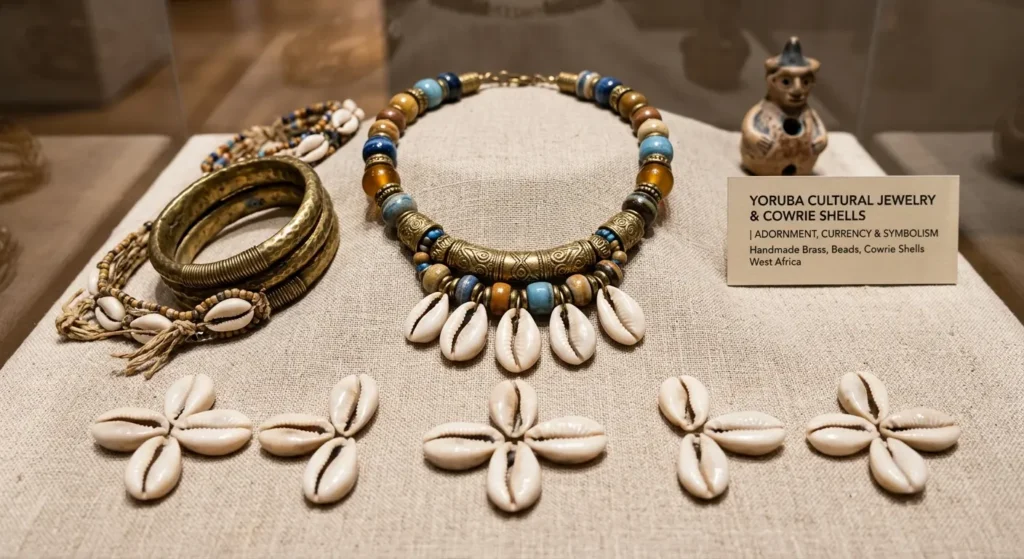
The Smithsonian’s documentation of Yoruba art also demonstrates that Oshun-related imagery can include cowrie shells and that cowries had important historical associations with wealth and divination. A Yoruba mask in the Smithsonian collection, for example, depicts a priestess of Oshun holding strings of cowrie shells. citeturn0search5
This provides a useful example of why it is better to discuss symbols within their cultural context rather than simply creating a generic list of “Oshun symbols.”
Oshun’s Colors
Yellow and gold are commonly associated with Oshun, particularly in many African diaspora traditions and contemporary representations.
These colors are often connected with themes such as beauty, radiance, wealth, and sweetness.
However, color associations can vary by religious lineage and cultural context.
For an educational article, we should therefore use language such as:
“Yellow and gold are commonly associated with Oshun in many traditions.”
rather than:
“Oshun’s color is yellow.”
The first statement recognizes variation. The second incorrectly suggests that one universal rule applies everywhere.
This distinction is particularly important when discussing Yoruba religion and its many regional and diasporic expressions.
Oshun and the Osun-Osogbo Sacred Grove
One of the most important places for understanding Oshun is the Osun-Osogbo Sacred Grove in Osogbo, Nigeria.
The site is not simply a tourist attraction.
It remains a living religious and cultural landscape.
UNESCO describes the grove as one of the last surviving examples of a once widespread Yoruba tradition of sacred groves associated with settlements. The site contains shrines, sculptures, artworks, sacred places, and worship points along the Osun River. citeturn1search0
The grove also hosts an annual festival that continues the relationship between the community and Osun.
UNESCO specifically recognizes the festival as part of the living cultural traditions of the Yoruba people and describes the grove as a symbol of wider Yoruba identity.
For someone studying Oshun, this location provides an important reminder that Yoruba religious traditions are not simply historical mythology.
They remain living cultural and religious traditions.
The Osun-Osogbo Festival
The annual Osun-Osogbo Festival is one of the most important public expressions of the living tradition associated with Oshun.
The festival takes place at the sacred grove and involves a processional relationship between the community, the sacred landscape, and Osun.
UNESCO notes that the annual festival occurs over twelve days in July and August and helps sustain the living cultural traditions associated with the grove.
This is significant for understanding Oshun because it demonstrates how religion, environment, community, art, history, and cultural identity can exist together.
The grove itself is part of the religious tradition.
The river is part of the religious landscape.
The artworks and shrines are part of the cultural heritage.
And the festival keeps the relationship between the community and the sacred site alive.
Oshun in Yoruba Tradition and the African Diaspora
Oshun is worshipped within Yoruba religious traditions and is also an important figure in several African diaspora religions.
As Yoruba people were displaced throughout the Atlantic world, religious traditions were preserved, adapted, and transformed in new environments.
This history is particularly important in the Caribbean and the Americas.
In Cuba, for example, Oshun is widely known as Ochún within Regla de Ocha, commonly known as Santería.
The traditions surrounding Ochún developed within the specific historical and cultural context of Cuba.
Therefore, Yoruba Oshun and Cuban Ochún should be understood as closely related manifestations within a wider historical tradition rather than assuming that every practice is identical.
Oshun and Other Orishas
Oshun is part of a much larger network of Orisha traditions.
Other important Orishas include:
- Elegua / Èṣù;
- Yemaya;
- Shango;
- Ogun;
- Obatala;
- Oya;
- Oshosi;
- Orunmila.
Understanding individual Orishas is useful, but they should not be studied as completely isolated figures.
Yoruba religious traditions contain relationships among Orishas, humans, nature, sacred places, stories, ritual practices, and communities.
That broader framework is why Oshun should be understood as part of Yoruba religious tradition rather than simply as a collection of modern spiritual symbols.
Continue reading:
Understanding the Orishas in Yoruba Tradition
Oshun and Yemaya: Are They the Same?
No.
Oshun and Yemaya are distinct Orishas, although both have important associations with water.
A useful starting distinction is:
Oshun → fresh water and rivers
Yemaya → sea waters and motherhood in many African diaspora traditions
The distinction is especially useful for beginners because modern spiritual content sometimes combines or confuses different water-associated Orishas.
Understanding these differences makes the study of Orishas more accurate and respectful.
Why Is Oshun Important?
Oshun remains important because her traditions connect several fundamental dimensions of human and natural life.
Water sustains life.
Fertility allows life to continue.
Beauty and attraction shape relationships.
Sweetness represents qualities of pleasure and harmony.
Abundance allows individuals and communities to flourish.
These themes come together around a sacred relationship with water and the natural world.
Studying Oshun therefore means studying more than an individual Orisha.
It also means learning about Yoruba relationships with nature, community, fertility, artistic expression, and sacred space.
How to Learn About Oshun Respectfully
Anyone beginning to study Oshun should approach the subject with cultural and historical awareness.
A few principles are particularly useful:
Distinguish Yoruba traditions from African diaspora traditions
Yoruba religious traditions developed in West Africa, while traditions such as Regla de Ocha developed in the Americas under very different historical circumstances.
They share important roots but are not identical.
Avoid reducing Oshun to a list of colors and objects
Yellow, gold, mirrors, jewelry, honey, and other associations can be useful when discussing particular traditions, but they do not define the entirety of Oshun.
Avoid presenting spiritual beliefs as scientific facts
Traditional associations should be described as religious or cultural beliefs.
For example:
“Oshun is traditionally associated with fertility.”
is more appropriate than:
“Oshun guarantees fertility.”
Recognize that practices vary
Different communities, lineages, and traditions may preserve different practices and interpretations.
There is no single internet checklist that can represent every tradition associated with Oshun.
Exploring Oshun and Orisha Traditions
Oshun is one of the most recognizable Orishas in Yoruba religious traditions and the African diaspora.
Her connection with fresh water, fertility, beauty, sweetness, sensuality, and abundance has made her an important figure across generations and communities.
Yet her significance is deeper than any single association.
The Osun River and the Osun-Osogbo Sacred Grove demonstrate how Oshun’s traditions connect spirituality, nature, cultural identity, art, and community.
For readers beginning their study of Yoruba spirituality, Oshun is an excellent example of why Orishas should be understood within their broader cultural and religious context.
Continue learning about the Orishas:
Understanding the Orishas in Yoruba Tradition
Who Is Elegua in Yoruba Tradition?
Yemaya: Meaning, Traditions & Connection to the Ocean
Shango: Meaning, Symbols, Traditions & Significance
For readers interested in exploring products connected with Orisha traditions, visit the relevant Oshun / Osha collection at Botanica Ire Orishas.