Elegua is one of the best-known Orisha figures associated with Yoruba religious traditions and with several religions of the African diaspora.
He is widely associated with roads, crossroads, communication, movement, choices, and the opening or closing of possibilities. At the same time, Elegua is a complex figure whose traditions cannot be reduced to a simple list of symbols or spiritual meanings.
One reason Elegua can be confusing for beginners is that several related names and traditions appear in discussions about him. You may encounter Elegua, Elegba, Eshu, Èṣù, or Eshu-Elegba, depending on the cultural, linguistic, and religious context.
These terms have historical and religious relationships, but they should not automatically be treated as completely interchangeable.
In Yoruba tradition, Èṣù is a significant divine figure whose role encompasses communication, choice, uncertainty, change, and the consequences of human action. Academic research emphasizes that Èṣù is much more complex than the common image of a mischievous “trickster.” He can also be associated with productivity, change, growth, judgment, and the dynamic nature of human life.
This guide explores who Elegua is, his relationship to Eshu, his place within Yoruba tradition, and why he became such an important figure in African diaspora religions.
Who Is Elegua?
Elegua is a name widely used for an Orisha associated with roads, crossroads, communication, choices, and movement.
Within Yoruba religious contexts, the related figure Èṣù has a particularly important role in the relationship between humans, the divine realm, and the consequences of human actions.
Because religious traditions developed across different regions and historical periods, the names and characteristics associated with this figure can vary.
In Yoruba contexts, the name is commonly written Èṣù or Eshu.
In Cuba and other parts of the African diaspora, Elegua or Elegguá became widely used.
The spelling Elegba or Elegbara may also appear in academic and historical sources.
These variations reflect linguistic and cultural differences rather than a simple naming convention.
What Does Elegua Represent?
Elegua is commonly associated with several concepts, including:
- roads and crossroads;
- communication;
- choices;
- movement;
- opportunity;
- uncertainty;
- change;
- boundaries;
- relationships between different realms.
These associations are useful for understanding Elegua, but they should not be treated as a complete definition.
Yoruba religious traditions do not necessarily reduce an Orisha to one function or personality trait.
The academic literature on Èṣù emphasizes his ambiguity and complexity. Joan Wescott’s research on Eshu-Elegba describes a figure associated not only with disruption and uncertainty but also with productivity, change, and growth.
This is important because popular descriptions sometimes portray Elegua exclusively as a “trickster.”
That description captures only part of the tradition.
Why Are Roads and Crossroads Associated With Elegua?
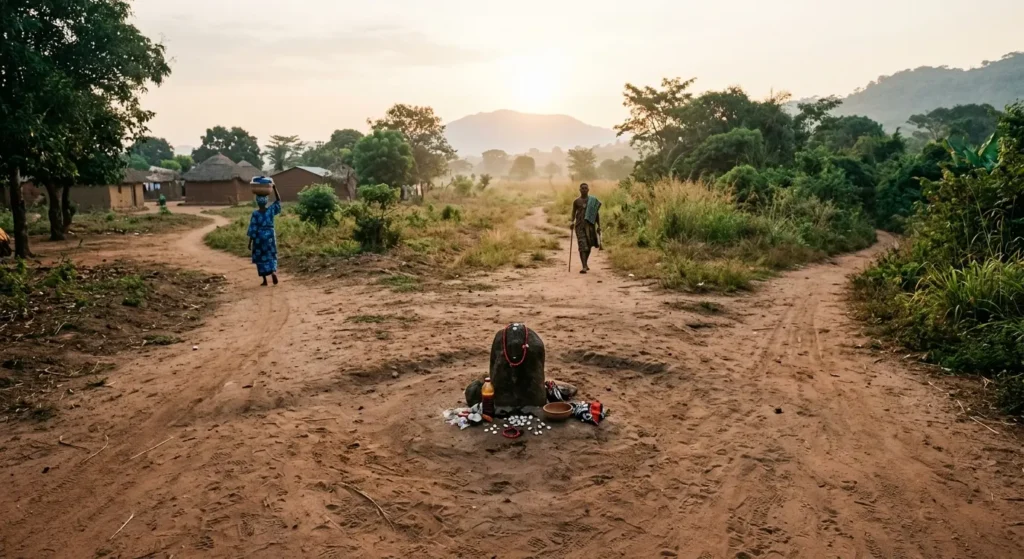
Roads and crossroads are among the most recognizable symbols associated with Elegua in Afro-diasporic religious traditions.
A crossroads naturally represents a point of decision.
A person arriving at a crossroads must choose a direction. In this sense, the imagery provides a powerful way to understand themes associated with Èṣù/Elegua: movement, decisions, uncertainty, possibility, and the consequences of one’s choices.
The symbolism also reflects a broader characteristic of Èṣù in Yoruba thought.
He is associated with situations in which human beings must act, interpret circumstances, make decisions, and respond to changing conditions.
For this reason, reducing Elegua to “the Orisha of roads” misses the broader philosophical significance of the figure.
Elegua and Communication
Communication is another important theme associated with Elegua and Èṣù.
Communication connects people, communities, and different realms of existence.
In religious traditions, this makes the figure particularly important because communication is essential to relationships between human beings and the divine.
The concept also has a practical dimension.
People communicate through words, signs, actions, decisions, and relationships. Misunderstandings can produce consequences, while clear communication can create opportunities.
Academic research on Èṣù highlights his connection with consciousness, information, judgment, and responsible action. One recent study describes Èṣù as a figure associated with awareness and the careful processing of information before human beings act or make judgments.
This provides a much richer way to understand why communication is such an important theme.
Is Elegua the Same as Eshu?
This is one of the most important questions when researching Elegua.
The answer requires context.
Elegua and Eshu are closely related names and traditions, but they should not automatically be treated as identical in every religious context.
In Yoruba religious tradition, Èṣù is the name generally associated with the Yoruba figure.
In Cuban and other African diaspora traditions, forms such as Eleguá became established.
Historical and religious transformations in the African diaspora produced their own terminology, ritual systems, and interpretations.
Academic research on Eshu-Elegba also demonstrates that even within Yoruba contexts, naming conventions can vary. Joan Wescott’s field research discusses both Eshu and Elegba/Elegbara and notes that the use of these names is not always completely straightforward.
Therefore, a responsible educational article should avoid saying simply:
“Elegua is exactly the same as Eshu.”
A better explanation is that Elegua and Eshu belong to closely connected religious traditions, while the meaning, terminology, and practices surrounding them depend on the specific cultural and religious context.
Elegua in Yoruba Tradition vs. Elegua in Santeria
The distinction becomes particularly important when comparing Yoruba religious traditions with Santeria, also known as Regla de Ocha.
Yoruba religious traditions developed in West Africa.
Regla de Ocha developed in Cuba within the historical context of the African diaspora and preserved and transformed important elements of Yoruba religious traditions.
As a result, the figure known as Eleguá in Santeria has important historical connections to Yoruba Èṣù, while the religious traditions surrounding the figure developed within a different cultural environment.
This means that readers may encounter different:
- names;
- stories;
- ritual practices;
- songs;
- symbols;
- religious terminology;
- and interpretations.
These differences should not automatically be treated as errors.
They are part of the history of how Yoruba religious traditions traveled, survived, and developed in the Americas.
Why Is Elegua Important?
Elegua is important because the traditions surrounding him address fundamental aspects of human existence.
People constantly encounter choices.
They move from one stage of life to another.
They communicate with other people.
They encounter uncertainty.
They make decisions whose consequences are not always immediately visible.
The symbolism associated with roads, crossroads, communication, and movement provides a religious framework through which these experiences can be understood.
This is one reason Èṣù has remained such a significant figure in Yoruba religious traditions and in related traditions of the African diaspora.
He represents something more complicated than simply “good luck” or “opening roads.”
The traditions surrounding him also involve uncertainty, responsibility, change, and the consequences of human choices.
Elegua and the Concept of Change
Change is another important theme associated with Èṣù.
Joan Wescott’s research describes Eshu-Elegba as an opponent of stagnation and notes his positive associations with productivity, change, and growth.
This provides an important counterbalance to the common description of Eshu as a mischievous or disruptive figure.
Change can create uncertainty, but it can also create new possibilities.
A crossroads is therefore not necessarily a negative place.
It is a point at which something can change.
That idea helps explain why Elegua has such a prominent place in traditions concerned with roads, movement, decisions, and communication.
Elegua as a Complex Orisha
One of the biggest mistakes beginners can make when studying Orishas is trying to assign each one a single definition.
For example:
Elegua = roads.
That may be easy to remember, but it is not enough.
A more useful approach is to think in terms of interconnected themes:
Elegua / Èṣù
→ roads
→ crossroads
→ communication
→ choices
→ uncertainty
→ movement
→ change
→ responsibility
→ opportunity
→ consequences
These themes interact with one another.
A road creates movement.
Movement creates choices.
Choices create consequences.
Communication influences decisions.
Change creates new possibilities.
This interconnectedness is part of what makes the figure so important within Yoruba religious thought.
How Is Elegua Represented?
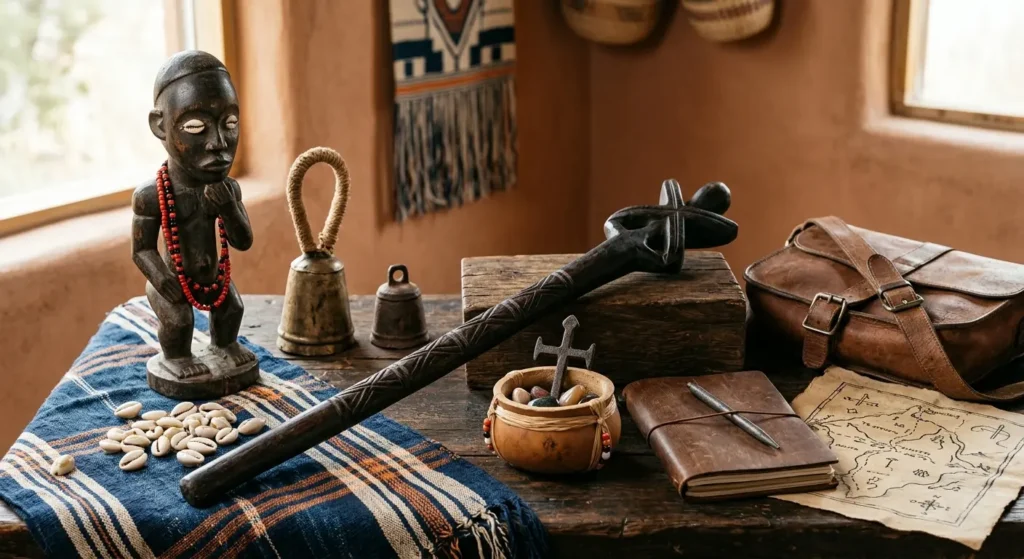
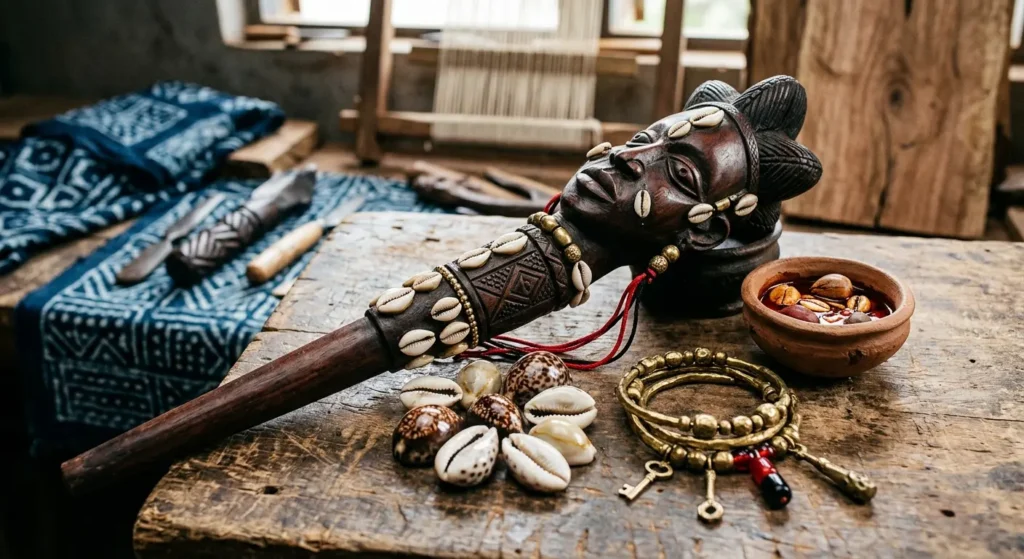
Representations of Eshu-Elegba vary considerably according to place, tradition, historical period, and artistic context.
Yoruba artistic traditions include sculptures and other representations associated with Eshu-Elegba. Academic research has specifically examined how these visual forms relate to myths, praise songs, ritual use, and broader Yoruba cultural values.
This is another area where it is better to avoid presenting one modern commercial image as the universal representation of Elegua.
Different communities may preserve different artistic and ritual traditions.
For Botanica Ire Orishas, this distinction matters particularly because images used in educational content should respect the diversity of these traditions rather than presenting a generalized “spiritual” aesthetic as if it represented all Yoruba communities.
Elegua and the Yoruba Orishas
Elegua is part of the broader world of Yoruba Orisha traditions.
Other widely known Orishas include:
- Oshun;
- Yemaya;
- Shango;
- Ogun;
- Obatala;
- Oya;
- Oshosi;
- Orunmila.
Each has its own traditions, stories, associations, and religious significance.
If you are beginning to study the Orishas, it is useful to understand them individually while also learning about the broader Yoruba religious framework.
Continue reading:
Understanding the Orishas in Yoruba Tradition
Elegua and Ifa
Elegua and Ifa are closely connected subjects, but they are not the same thing.
Ifa is a major Yoruba divination tradition associated particularly with Orunmila and a complex body of sacred knowledge.
Èṣù also appears within Yoruba religious thought in relationship to Ifa and questions of communication, action, uncertainty, and consequence.
This relationship makes Elegua an important bridge between the broader Orisha cluster and the site’s future Ifa content cluster.
Learn more:
What Is Ifa? Understanding the Yoruba Divination Tradition
Learning About Elegua Respectfully
If you are new to Yoruba spirituality, approach information about Elegua with cultural and historical context.
A respectful approach means recognizing that:
- Yoruba religious traditions are living traditions;
- African diaspora traditions developed within different historical circumstances;
- terminology can vary between communities;
- not every popular internet description represents traditional Yoruba perspectives;
- Orishas should not be reduced to lists of colors, numbers, or personality traits;
- religious practices should not be presented as guaranteed supernatural mechanisms.
Academic research is particularly valuable because it can help distinguish historical Yoruba traditions from modern commercial interpretations.
The study of Èṣù is a good example. Scholarly research has specifically criticized interpretations that remove Èṣù from his native Yoruba cosmology and reduce him to simplified categories.
Exploring Elegua and Orisha Traditions
Understanding Elegua is an important step toward understanding the wider world of Yoruba Orisha traditions. Explore the Elegua collection at our store.
His associations with roads, crossroads, communication, choices, change, and uncertainty reveal why he cannot be reduced to a single definition.
If you would like to continue exploring the Orishas, start with our broader guide:
Understanding the Orishas in Yoruba Tradition
You can also explore related educational resources as they become available:
- Oshun: Meaning, Symbols, Traditions & Spiritual Significance
- Yemaya: Meaning, Traditions & Connection to the Ocean
- Shango: Meaning, Symbols, Traditions & Significance
- Ogun: Meaning, Symbols, Traditions & Significance
- What Is Ifa? Understanding the Yoruba Divination Tradition
For readers interested in spiritual items connected with Orisha traditions, you can also explore the Osha collection at Botanica Ire Orishas.
The goal is not simply to learn a list of names and symbols, but to understand the cultural and religious traditions behind them.